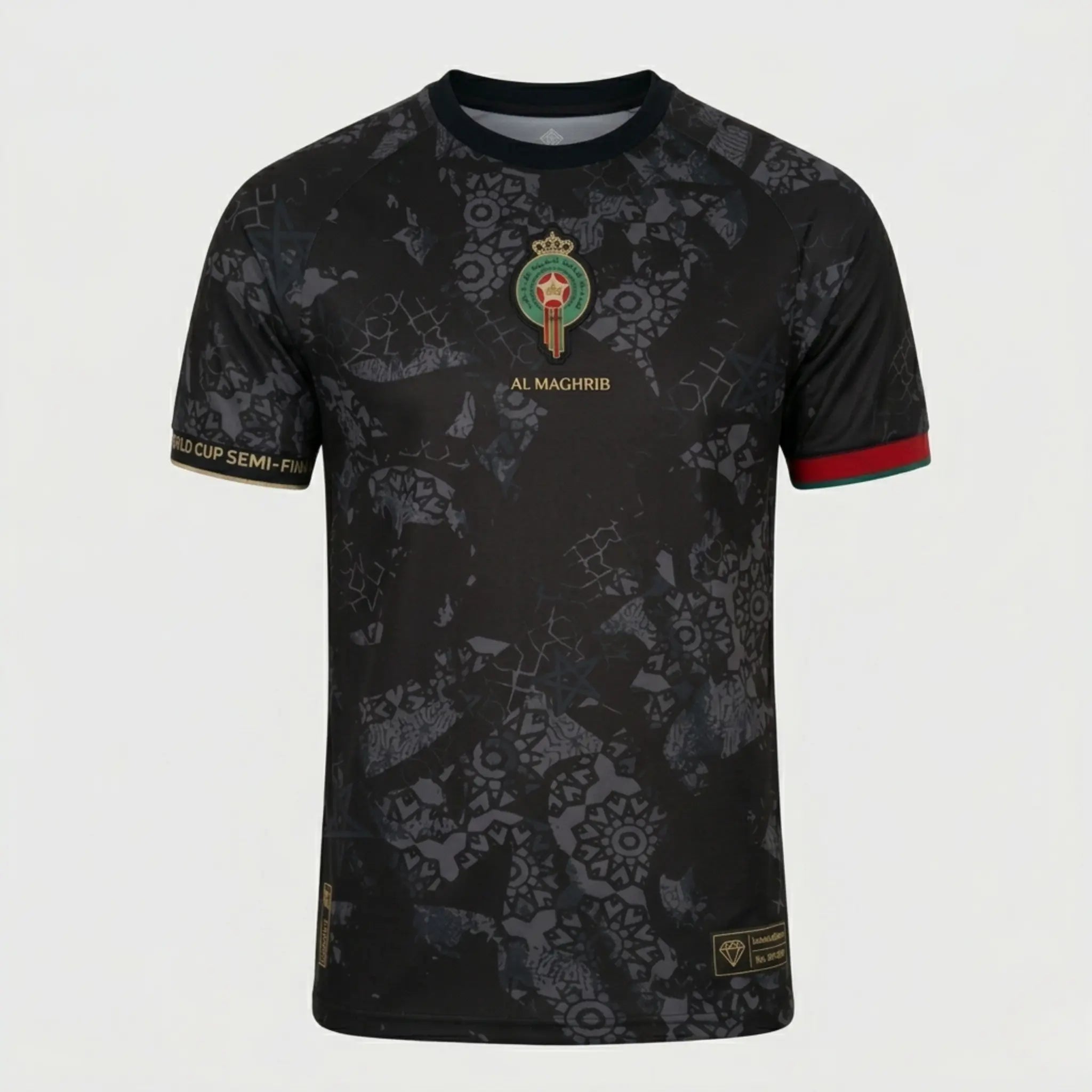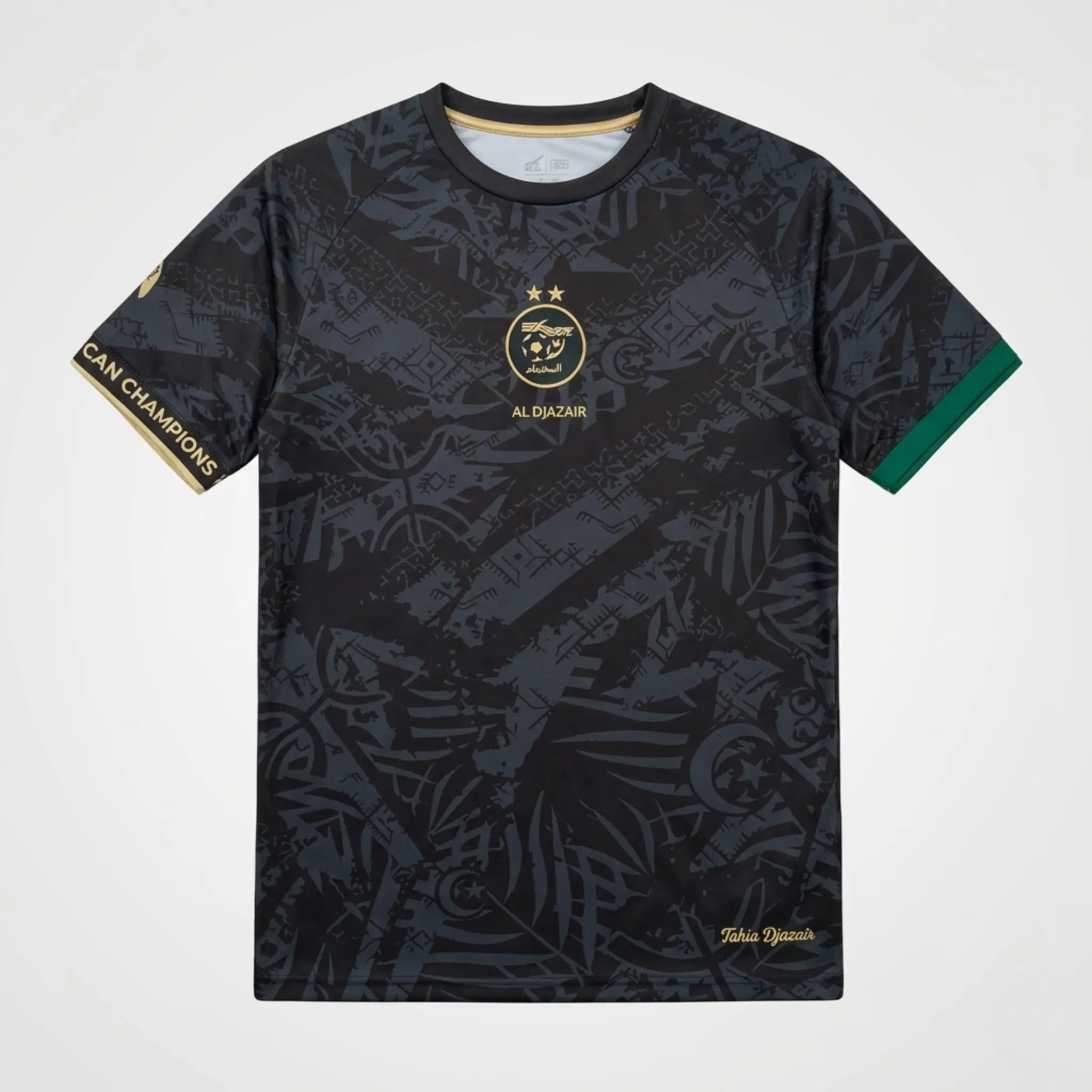
THE Morocco national team jersey is one of the most recognizable in African football. Red at home since its inception, white away, it carries seventy years of football and national identity in its very fabric. In short: Morocco has played in red since joining FIFA in 1956, with major developments every decade and a lasting partnership with Puma since the 2000s.
This article traces each major period of the Moroccan jersey: the first handcrafted outfits of independence, the glory years of the World Cups, the move upmarket in the 2000s, and the contemporary designs that have transformed the Morocco jersey as a sought-after collector's item worldwide.
The origins of the Moroccan jersey, the birth of a football identity
Morocco gained independence in 1956 The Royal Moroccan Football Federation was founded the same year. The national team began competing on the continental stage in simple kits, predominantly red for home matches and white for away games, colors directly inherited from the national flag. The first jerseys were made locally, without an international supplier, using simple materials and a loose fit typical of the time.
Red and green, a choice full of meaning
The red and green combination of the Moroccan flag naturally serves as the color scheme. Red dominates the home kits, while the green of the flag's star is gradually incorporated into the details: collar, sleeves, crest. This choice is not insignificant in a post-independence context where the national team also serves as a showcase of identity for a country building its image on the international stage.
The first continental tournaments
Morocco plays its first CAN in 1976 in Ethiopia, where they won the title. This was the continental crowning achievement of the Atlas Lions, sporting a simple, red, round-neck jersey, lacking in graphic sophistication but imbued with powerful symbolism. This era laid the visual foundations that all subsequent generations would adopt.
The years 1980 and 1994, Morocco on the world stage
Participation in 1986 World Cup The tournament in Mexico marked a major turning point. Morocco became the first African and Arab country to advance past the first round of a World Cup. The kits worn during this historic tournament remain etched in the collective memory: bright red at home, immaculate white away, with the initials FRMF embroidered on the chest.
The 1986 World Cup, a jersey that has become a symbol
Against England, Poland, and Portugal, and then in the round of 16 against West Germany, the Atlas Lions wore a deliberately simple jersey. The federation crest was stitched in the center left, and the number was printed on the back in white flocking on a red background. This minimalist design is now highly sought after in the football market. vintage jerseys Moroccans.
1994: return to the World Cup with a modernized kit
Having missed the 1990 World Cup, the team returned to the United States in 1994 with a more elaborate jersey. Side cutouts appear, the materials become more synthetic, and the graphics are more sophisticated. This marks the beginning of a transition towards the standards of the major international sportswear manufacturers who will dominate the following decade.
The Puma era and the upgrading of the Moroccan jersey
Puma became the official kit supplier for Morocco in the early years 2000 and gradually transforms the design of Morocco jersey. Technical fabrics were introduced, designs became more sophisticated, and the royal crest was prominently featured at the center of a more elaborate graphic composition. This partnership continues to this day and has produced some of the most talked-about jerseys in African football.
Jerseys from the 2000s and 2010s
The period from 2000 to 2015 saw a standardization of Moroccan kits in the Puma style of the time: DryCELL fabric, fitted cuts, and graphic details on the shoulders and sides. Red remained dominant for home games, but away versions explored off-white, dark green, and even shades of burgundy depending on the season.
The 2021 Africa Cup of Nations and the graphic redesign
There CAN 2021 contested in Cameroon in January 2022 This marks a new aesthetic turning point. Puma presents a red home jersey for Morocco featuring geometric patterns inspired by Moroccan zellige, the traditional tilework found in the country's architecture. This is the first time an element of Moroccan artisanal heritage has been so explicitly integrated into the official design.
The pink jersey and special editions: when Morocco surprises
In 2024, Puma launched a pale pink away kit for Morocco that immediately sparked both controversy and enthusiasm. Unofficially dubbed the "pink jersey," this design reflects a growing trend among sportswear manufacturers to use bold colors for the third and away kits of African national teams. In just a few weeks, this Morocco pink jersey becomes one of the most discussed on social media.
Why did pink divide the fans so much?
Some fans see it as a break with Morocco's traditional red and green colors, a concession to marketing rather than identity. The other side argues that major international national teams, from Germany to the Netherlands, have all had unconventional jerseys that have become iconic over time. The debate remains open, but sales figures have settled the matter: the pink jersey sold much faster than the classic versions.
Palestine tribute jerseys and solidarity editions
In the wake of the events of 2023, unofficial and semi-official versions of Morocco jersey These jerseys incorporate Palestinian colors or explicit messages of solidarity. They are not produced by Puma but by independent companies responding to a genuine demand from fans who want to combine Moroccan pride with a political message. The distinction between the official jersey and the tribute jersey is crucial here.
The 2022 World Cup jersey, the pinnacle of a golden generation
There 2022 World Cup The tournament in Qatar will remain the most memorable footballing achievement in Moroccan history. Finishing fourth in the world and eliminating Spain, Portugal, and Belgium, the Atlas Lions wore a dark red jersey with graphic details inspired by Moroccan architectural motifs. This jersey is now considered one of the most beautiful in the competition's history.
Hakimi, Bounou, En-Nesyri: the faces that have worn this jersey
Achraf Hakimi, Yassine Bounou, and Youssef En-Nesyri have made this jersey world-famous. Every image of Bounou saving a Spanish penalty or of Hakimi celebrating is associated with this specific kit.In the market for flocked jerseys, the number 2 Hakimi and the number 1 Bounou's flocking designs were among the most requested in Europe between November and December 2022. If you wish to wear the Moroccan colors with your own identity, the collection Custom Morocco jersey allows you to choose your name and number on designs inspired by these iconic editions.
The Morocco 2025 jersey: a contemporary design blending tradition and modernity
For the cycle 2025-2026, Puma presents a new collection for Morocco with a clean, minimalist aesthetic. Red still dominates, but the cuts and graphic details are lighter, resulting in a more modern look. Fabric technology has also evolved: new materials are 30 to 40% lighter than previous generations, with an improved thermoregulation system.
The 2025 home jersey
The home version retains the historic bright red with a subtle V-neck and a royal crest repositioned slightly higher on the chest. Green details are limited to the collar and sleeve trim, resulting in a more understated silhouette than previous editions. Puma is clearly prioritizing maximum visibility for television broadcasts.
The 2025 away kit
The away kit is white, with graphic inserts inspired by traditional Moroccan textile patterns. This continues the artistic direction initiated at the 2021 Africa Cup of Nations, which integrates Moroccan cultural heritage into sports design. This type of approach has become a signature of Puma for the African national teams it sponsors.
FAQ
Since when has Morocco played in red?
Morocco has played in red since the creation of its national team in 1956, the year of the country's independence. The color red comes directly from the national flag. This chromatic tradition has never been abandoned, even though the shades and designs have evolved with each kit manufacturer and each generation of jerseys.
Who is the official equipment supplier for Morocco?
Puma has been the official kit supplier for the Moroccan national team since the early 2000s. This partnership has lasted for over twenty years and has produced the jerseys for the 2018 and 2022 World Cups, as well as several editions of the Africa Cup of Nations. The contract also covers the youth teams and the women's national team.
Which is the most iconic Morocco jersey in history?
The 2022 World Cup jersey in Qatar is widely considered the most iconic. Worn during Morocco's historic run to the World Cup semi-finals, it combines a design inspired by Moroccan architectural heritage with exceptional sporting performance. The more understated 1986 World Cup jersey, on the other hand, is the most sought-after by vintage collectors.
Why did Morocco's pink jersey cause so much of a stir?
Launched by Puma in 2024 as an away kit, the pink jersey surprised many with its complete departure from traditional Moroccan colors. Despite initial controversy, it sold out very quickly, fueled by its visibility on social media. It reflects a general trend among sportswear manufacturers to offer bold third kits to generate attention.
Can you find retro Moroccan jerseys?
Yes, vintage Moroccan jerseys from 1986, 1994, and 1998 can be found on specialized platforms like Classic Football Shirts or eBay. Official reissues are rare: Puma has not yet launched a retro collection dedicated to Morocco, unlike some European clubs.The prices of authentic originals vary between 80 and 250 euros depending on the condition and flocking.
What this jersey says about Moroccan identity
Seventy years of national football condensed into a red fabric. The Morocco jersey It has gone from a post-independence handcrafted garment to an international fashion product in two generations. Each design tells a story, each star on the jersey represents a victory.